Let’s be honest about something. Germany is not just another country on the trade fair circuit. It is the trade fair capital of the world. More than two-thirds of the world’s leading international exhibitions take place here — Hannover Messe, Interpack, Automechanika, IFA Berlin, electronica, Gamescom. The numbers are staggering, the competition is relentless, and the stakes are as high as they get in business.
And yet, every year, international firms go to German trade fairs and make the same mistakes when exhibiting in Germany. Not little mistakes. Expensive, brand damaging, lead killing mistakes that might have been prevented totally with a little bit of prep and the right people in their corner.
Whether you are a first time exhibitor or a fifth time exhibitor, this handbook is for every brand exhibiting in Germany. We’ll discuss the most common mistakes we notice, why they happen, and what you can do to avoid them. By the time you’ve finished reading this, your next German trade fair will seem drastically different.
Germany hosts over 150 major international trade fairs per year. Getting your exhibition stand wrong here doesn’t just cost you money — it costs you the room.
Mistake 1: Treating a German Trade Fair Like Any Other Show
The first and most common mistake is simply underestimating the environment. Brands that exhibit successfully in the US, the UAE, or Southeast Asia arrive at Messe Frankfurt or Koelnmesse with the same stand, the same approach, and the same expectations — and then wonder why the results are different.
Here is the reality. German trade fairs operate at a different level of professionalism. Visitors are more technologically literate, analytical and significantly less likely to fall for glitzy advertisements. A German purchasing director touring the floor at Hannover Messe is not there to be entertained. They are there to examine, compare and make tough sourcing selections.
What this means for your booth:
- Visual appeal is not enough, your show stand design must demonstrate credibility and technical authority
- Demos of products should be tight and substantive…not theatrical
- Your team needs to be briefed on handling detailed technical questions from day one
- Your collateral needs to be informative and data-led, not just glossy brochures
The brands that perform best in Germany treat it as a different market from day one of planning — not an afterthought.
Mistake 2: Missing the Messe Deadlines
German Messe venues run on tight, strictly enforced schedules. Build-up windows open and close on a fixed timetable. Late contractor registrations are declined. Late material submissions are not accepted. If your stand is not ready when the show opens, it is not ready — and there is no negotiating your way around that.
International brands frequently underestimate how early the paperwork process starts. The Messe documentation requirements — contractor registration, structural engineering submissions, electrical plans, rigging applications — often need to be submitted weeks or even months before the show opens. This is not bureaucracy for its own sake. German venues are managing hundreds of exhibitors simultaneously, with strict safety and logistics protocols.
The typical Messe documentation timeline:
- 12–16 weeks before: Stand design finalised and contractor registered with the venue
- 8–12 weeks before: Structural engineering documents submitted for approval
- 6–8 weeks before: Electrical plans, rigging applications, fire safety certificates submitted
- 4–6 weeks before: Logistics and freight arrangements confirmed with venue handlers
- Build-up week: Stand installed within the venue’s strictly allocated build-up hours
Miss any of these windows and the consequences cascade. A late structural submission means your design cannot be approved. An unregistered contractor cannot access the hall. This is why working with an Exhibition Stand Builder in Germany who already holds the necessary venue registrations is not optional — it is the only way to guarantee your stand goes up on time.
We have never missed an installation deadline at a German venue. Not once. That is only possible because the process starts early and every step is tracked.
Mistake 3: Ignoring German Electrical Regulations
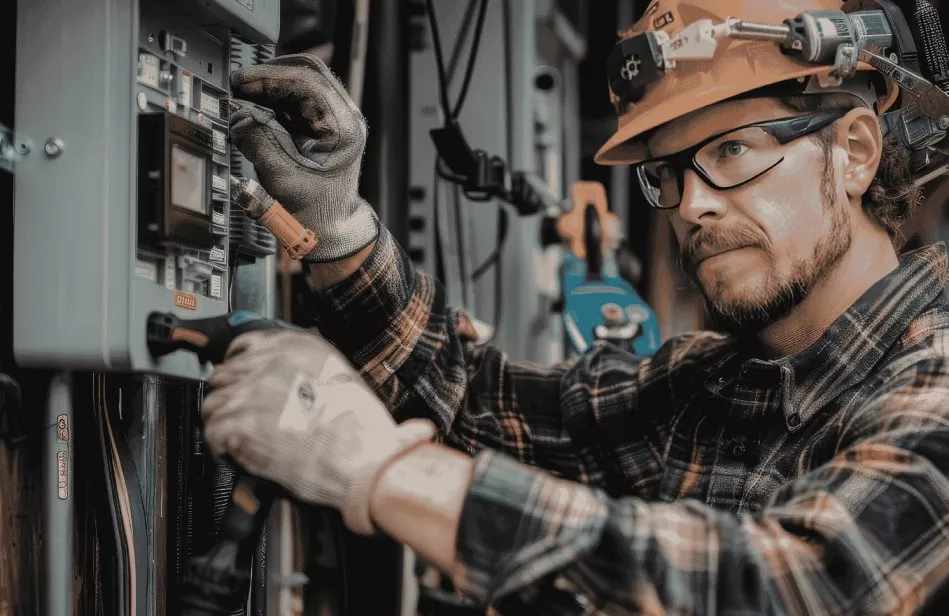
European electrical standards are very different from those in North America, Asia and the Middle East. The voltage in Germany is 230V/50Hz. Note: Equipment purchased in the USA (110V/60Hz) requires appropriate voltage conversion, not just plug adaptors. Apparatus imported from countries with differing safety certification standards may not meet the TÜV or CE requirements of German venues and German law.
This is not a minor technicality. Venues can refuse to connect stands that do not meet their electrical regulations, and they will. We have seen brands arrive with beautifully designed stands, expensive AV equipment, and illuminated displays — none of which could be powered up because the electrical setup was not compliant.
The key electrical compliance requirements for exhibiting in Germany:
- All electrical installations must be completed by a certified electrician registered with the venue
- Electrical plans must be submitted to the venue before build-up for approval
- Equipment must carry CE certification to operate in Germany
- US equipment running on 110V requires either dual-voltage models or certified step-down transformers
- Extension leads and power distribution must meet German DIN standards
- All lighting must be mounted and directed so as not to spill into neighbouring stands
The safest option is to get your AV equipment and electrical components from Germany or Europe, or to check compliance with your exhibition stand builder in Germany before anything ships.
Mistake 4: Skipping Translation and Localisation
You’d be astonished by the number of multinational firms who turn up to German trade fairs with displays, collateral and internet content all in English. Generally speaking, some make the case that German business people speak English well. And that is so. But it completely misses the point.
Language is not just about being understood. It is about respect, professionalism, and showing that you have made the effort to meet your audience on their terms. German visitors notice when a brand has invested in German-language communication. They notice even more when a brand has not.
But localisation goes further than translation. German business communication has specific conventions:
- German professional copy is formal in register — ‘Sie’ (formal you), not casual or overly familiar tone
- German viewers are receptive to accuracy and specificity – claims need proof, numbers and technical depth
- Marketing language that relies on superlatives and vague promises (‘the best’, ‘world-leading’) is received with scepticism
- Product literature should lead with specifications and performance data, not lifestyle imagery
Have your stand graphics, leaflets, product sheets, and digital content translated and reviewed by a native German business speaker — not machine-translated, not translated by a team member who ‘speaks a bit of German’. The difference in how you are perceived on the show floor is significant.
We have never missed an installation deadline at a German venue. Not once. That is only possible because the process starts early and every step is tracked.
Mistake 5: Getting Exhibition Logistics and Customs Wrong
Shipping exhibition materials to Germany involves navigating international freight, customs documentation, and venue-specific logistics requirements. For brands outside the EU, this means ATA Carnets, customs declarations for temporary imports, and compliance with EU import regulations. Get this wrong and your stand materials sit in a customs warehouse while your show opens without them.
Even within Europe, German Messe venues have specific logistics requirements that differ from venue to venue. Messe Frankfurt has different unloading procedures to Messe Düsseldorf. Koelnmesse has specific time windows for freight delivery. Hannover Messe — the largest trade fair venue in the world — requires careful coordination of the logistics sequence to get materials to your hall, to your bay, and into your space without delays that affect neighbouring exhibitors.
Key logistics requirements to get right:
- ATA Carnet: Required for all temporary imports into Germany from outside the EU
- Customs broker: For non-EU brands, a licensed customs broker familiar with trade fair temporary imports is essential
- Official freight forwarder: The vast majority of large venues in Germany have an official freight handling partner – utilise them for on-site delivery coordination
- Packing specifications: Materials must be packed to survive European freight handling and clearly labelled in German (hall, booth number and exhibitor name).
- Return shipping: Make arrangements to return all products prior to the concert – you cannot leave uncollected items at the venue
Working with an exhibition stand builder in Germany who manages European logistics directly removes most of this complexity. When your stand is designed, fabricated, and installed by the same team that handles the freight, the coordination risk is essentially eliminated.
Mistake 6: Underestimating German Exhibition Culture and Etiquette
German business culture at trade fairs has specific norms that international brands frequently misread. Understanding them is not about being overly formal or stiff — it is about making the right impression on the visitors and buyers who matter most to you.
What German trade fair visitors expect:
- Punctuality: Meetings arranged at the stand are expected to start on time, every time
- Substance over style: Visitors want to talk product specifications, performance data, and delivery capabilities — have your technical team present and briefed
- Business cards: Exchanged formally, read properly, not stuffed in a pocket — this still matters in German business culture
- No hard selling: Aggressive sales approaches are counterproductive. German buyers make decisions methodically; they respond to informed, consultative conversations
- Quiet professionalism: Loud music, gimmicks, and entertainment-focused stand activations tend to alienate rather than attract the German professional visitor
The most effective German trade fair stands create an environment of professional credibility. Clear product messaging, competent staff, well-organised demonstration areas, and a clean, considered exhibition stand design that signals quality and investment — that is what generates the right conversations at German shows.

Mistake 7: Choosing the Wrong Stand Builder for Germany
This is the mistake that underlies all the others. Most of the problems covered in this guide — late deadlines, compliance failures, logistics errors, electrical issues — come down to working with a stand builder who does not know Germany.
A stand contractor based in your home market may produce excellent work domestically. But if they are not registered with German Messe venues, not familiar with TÜV electrical requirements, not experienced with European freight logistics, and not connected to local German installation crews, they are going to make mistakes that cost you time, money, and credibility.
When evaluating an exhibition stand builder for your German trade fair, ask these questions:
- Are you registered as an approved contractor at the specific venue we are exhibiting at?
- Have you installed stands at this venue before — and when most recently?
- Do you handle German electrical compliance in-house, or do you subcontract it?
- Can you manage European freight logistics and ATA Carnet documentation?
- Do you have a local installation crew on the ground in Germany?
- What is your process if something goes wrong during build-up?
The answers to those questions tell you immediately whether you are dealing with a genuine Germany specialist or someone who is going to learn on your budget.
We are registered at every major German Messe venue. We manage design, fabrication, logistics, and installation entirely in-house. And we have never missed an installation deadline.
Upcoming German Trade Fairs — Is Your Stand Ready?
If you are planning to exhibit at any of these future German trade fairs, the preparation process has to start immediately. German Messe deadlines do not wait, and the best stand builders book up months in advance.
- electronica 2026 — Munich, 10–13 November 2026 (Electronics)
- Agritechnica 2026 — Hannover, November 2026 (Agricultural Technology)
- Formnext 2026 — Frankfurt, November 2026 (Additive Manufacturing)
- BAU 2027 — Munich (Architecture, Materials, Systems)
For any of these events, Exhibit Elevate may provide a free 3D idea within 48 hours of your brief – at no cost and with no obligation. That means you can see what your booth will look like on a German trade fair floor even before you have spent a single euro.
Ready to Exhibit in Germany Without the Mistakes?
The difference between a successful German trade fair and a costly letdown lies in three things: planning, the correct local expertise and an exhibition stand created exclusively for the German market.
Germany’s trade fair floors are the most competitive exhibition environments in the world. Visitors are serious, the competition is relentless, and venues are unforgiving of brands that show up underprepared. You get one shot to make the right impression on buyers who have flown in from 50 countries to evaluate suppliers exactly like you. Your stand is the first thing they see. Make it count.
At Exhibit Elevate, we handle everything — concept design, fabrication, European logistics, venue registration, on-site installation, and post-show dismantling — all in-house, with a dedicated project manager on every account and a guaranteed 3-week production process.