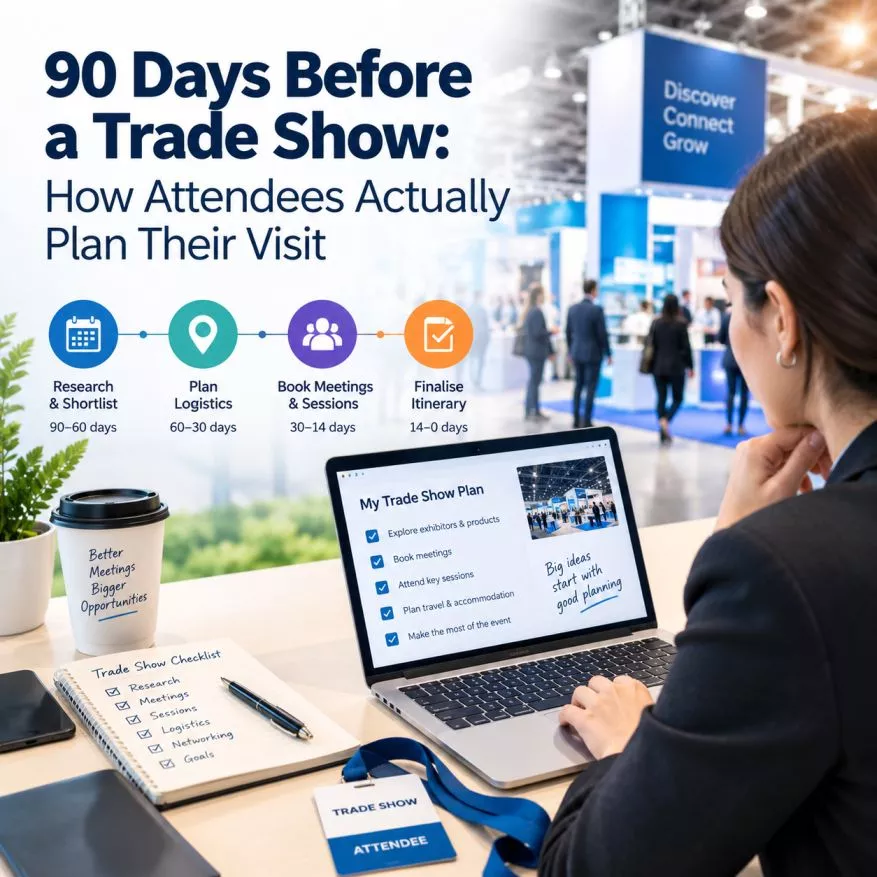
An exhibitor’s final 90 days are mostly operational. Booth design gets signed off. Freight is booked. Staff are assigned, collateral goes to print, badge orders are submitted. It is a countdown made of deadlines, and almost all of them are internal — the kind of end-to-end planning process that determines whether a stand is even ready on time.
An attendee’s final 90 days are a countdown made of decisions. Is this trip worth the budget? Which show, if any? Who do I need to see while I’m there? What do I need to come back with to justify having gone?
Both run at the same time. They touch each other far less than exhibitor planning tends to assume, because most of what decides who walks up to a stand happens on the attendee’s side of the line, in places the exhibitor never sees.
Discovery is early, and it is not where people drop out
It is tempting to treat the first stretch as an awareness problem. The research does not really support that.
Freeman recently surveyed a large group of professionals who fit an event’s target audience but had never attended it. The people who stayed away were not unaware of the show. They knew it existed and had decided it probably would not repay the time and the cost. The strongest thing that would have changed their minds was the promise of something they genuinely could not get remotely.
So being found is largely solved. Being chosen is not, and the choosing happens earlier and more quietly than it used to.
Forrester’s latest buyer research found that AI now sits somewhere in almost every B2B buying process, and that buyers rate conversational search above vendor websites and sales conversations as a source they find meaningful. Applied to events, the practical effect is this: when someone asks an assistant which shows matter in their field, or looks up what is happening in their sector this quarter, the answer gets assembled from show sites, exhibitor directories, event discovery platforms and whatever third-party listings describe the category.
Those descriptions are doing qualification work on a buyer’s behalf about three months out, with nobody from the exhibiting company in the room. A vague listing is not a neutral outcome at that stage. It is a quiet loss in a comparison that was never announced. Checking which shows are coming up in your sector is a useful starting point — but the deeper issue is what a buyer finds once they look past the listing.
The booking decision arrives later than the plan assumes
Most pre-show outreach is built against the registration list, on the reasonable assumption that the list is broadly complete a month or two out. It usually is not.
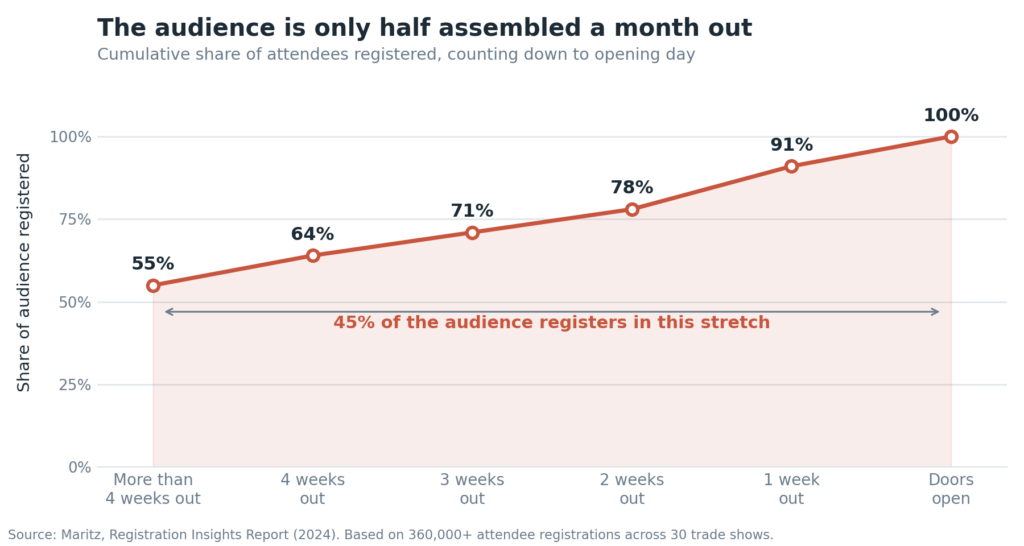
Maritz analyzed more than 360,000 attendee registrations across 30 trade shows. Tracked as a running total, the audience assembles in a shape worth knowing.
With a month to go, only about 55% of the eventual audience has committed. Roughly 45% register inside the final four weeks, and around one in eleven does not register until arriving on site. Anything planned entirely off the registration file is aimed at a room that is barely half assembled.
The shape of the line matters more than any single point on it. The audience does not arrive as one early wave and then trickle. It keeps forming right up to the doors, and the steepest single stretch is the last week before opening.
The late half is also the more interesting half. First-time attendees register late at close to twice the rate of returning ones, and people within driving distance leave it far later than those booking flights. The part of the audience that has never seen your stand is disproportionately the part that has not registered yet.
There is a useful corollary buried in the same dataset. The earliest registrants turn out to spend the least once they arrive. Booking eight months ahead tends to signal routine attendance rather than strong intent, while the people making a deliberate choice decide later and then commit properly.
Marketing in this window has to work without a conversation
The middle stretch is where a shortlist quietly forms, and very little of it involves speaking to anyone who is selling.
Gartner’s work on B2B buying groups found that meeting suppliers accounts for only a small share of the total time a buying group spends. The overwhelming majority goes to research the supplier never witnesses. Forrester now puts a typical business decision at more than a dozen internal stakeholders plus a similar cluster of outside influencers.
Two things follow for anyone marketing an event or a stand in this period. Your material will be read by people who never identify themselves and who have no relationship with you, so it has to make sense cold. And it will be compressed before it reaches the decision, either by an assistant summarizing it or by the one colleague who actually attends and reports back.
Specific claims survive that journey. Product names, applications, the particular problem you solve. Category language does not, because there is nothing in it to carry forward.
Registered is not the same as attending
The final stretch usually gets treated as logistics: confirm the date, share the venue, explain the parking. The drop-off data suggests it deserves more than that.
Across more than a thousand live events, roughly one in five people who registered did not check in. That decision is made in precisely the window where communication has typically been reduced to administration.
What attendees say they want in those last weeks is more substantial. Freeman’s experience research, produced with IMEX, found a consistent mismatch: attendees want help navigating the floor, choosing sessions and finding the right people to meet, while organizers are best at personalizing the things attendees care least about, including badges, registration, and food.
The same body of work found that attendees increasingly treat the floor itself as the main learning channel rather than the session rooms — which puts real weight on what happens once they’re standing in front of a stand that’s actually built to hold their attention. That reframes the last email before a show. A reminder that helps someone plan a route, flagging what is new and who will be there, is doing different work from one that confirms a date.
Closing the gap between the two countdowns
None of this argues for spending less on the show itself. It argues that the days on the floor are the visible end of something that started around twelve weeks earlier, and that the earlier part is legible enough to plan against.
- Assume the audience is still forming. Nearly half of registrations land in the final month, weighted toward first-timers. Plans built only on early registrations miss the newest part of the room.
- Write for a reader with no context. Most evaluation happens without contact and often survives only as a summary. Specifics travel; positioning language does not.
- Treat the last weeks as persuasion, not administration. With one in five registrants not turning up, the final communications are still doing convincing work.
The doors opening marks the end of the attendee’s planning, not the start of it. By then the shortlist is written and the route is roughly drawn.
Where the exhibitor's countdown actually matters
Everything above happens before a single visitor reaches the floor — which is exactly why the exhibitor’s own 90 days can’t just be a checklist of deadlines. If the shortlist is written before the show opens and the route is drawn before the first badge scan, the stand itself has to do the convincing in the few seconds it gets, for a visitor who has already decided you’re worth the walk over.
That’s the part of the countdown Exhibit Elevate works on: a stand designed to earn that decision on sight, built and delivered on a timeline that doesn’t slip, so the other ninety days of attendee research end at your booth rather than a competitor’s. If you’re already three months out from a show, get a free 3D concept and see what your stand could look like before the audience finishes forming.